Tree Trimming in Crockett's Ridge - Apex, NC
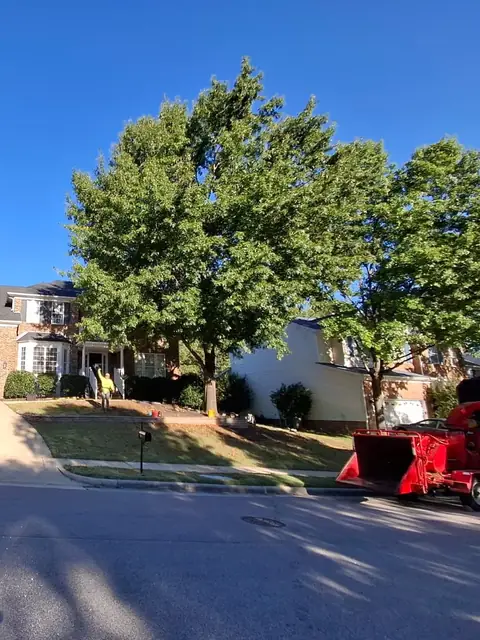
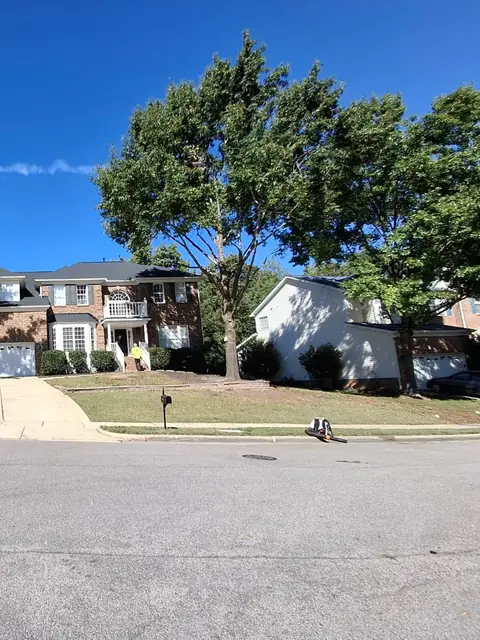
Two large front-yard shade trees were trimmed at a home in the Crockett's Ridge community of Apex, NC.
Residential and commercial tree trimming
Careful tree pruning that clears roofs and driveways, removes dead wood and improves structure, plus shrub and bush trimming around your home.
Trimming is one of the most useful things you can do for the trees on your property, and one of the easiest to get wrong. Done well, it removes hazards, clears structures, improves the tree's form and helps it hold up better in storms. Done poorly, with too much canopy removed or cuts made in the wrong places, it can stress a tree for years. e Tree Service provides tree trimming and pruning for homes and commercial properties across the Triangle, with an emphasis on taking what needs to go and leaving the rest.
Dead limbs are the most common reason for a trimming call. Dead branches do not flex the way living wood does, and they can break and fall in a light wind. Over a driveway, patio, play area or parking lot, they are a real hazard.
Overgrown limbs slowly take over space. Branches reach over roofs, rub against siding, crowd windows and fill gutters with leaves and needles. Limbs that rest on or scrape a roof can damage shingles and give squirrels an easy route inside. Roof and building clearance trimming lifts and shortens those limbs so the tree and the structure can coexist.
Driveway and walkway clearance keeps low limbs from scratching vehicles, blocking delivery trucks or forcing people to duck. On commercial properties, clearance over parking areas, sidewalks, entrances and signage is often the main goal.
Storm preparation matters in a region where summer thunderstorms, hurricane remnants and occasional ice storms put real loads on trees. Removing dead wood, weak attachments and overextended limbs reduces the chance of breakage when the weather turns.
Structural concerns such as crossing and rubbing branches, co-dominant stems with weak unions or heavy limbs growing at awkward angles can often be addressed with selective pruning, especially when a tree is younger.
Appearance and light are also good reasons. Thinning a dense canopy can let more light reach the lawn and garden and make a mature tree look better balanced.
Leaves are how a tree feeds itself. Every living branch removed takes some of that capacity away, so good pruning is selective. We aim to remove dead, damaged and problem limbs and to make clearance cuts where they are needed, while keeping as much healthy canopy as the tree can use.
We avoid topping, the practice of cutting large trees back to stubs to reduce their height. Topping creates big wounds that decay, and the tree often responds with a flush of weakly attached sprouts that can become a hazard of their own. If a tree has truly outgrown its space, reducing it carefully or removing it is usually a better answer, and we will tell you honestly which makes more sense.
Where we cut matters as much as how much. Cuts made just outside the branch collar, the slightly swollen area where a branch meets the trunk or a larger limb, allow the tree to seal the wound over time. Stubs and flush cuts both slow that process.
Large, mature oaks, maples, poplars and pines are common across the Triangle, and they often stand close to homes built decades after the trees were. Trimming them usually means climbing or using a lift, cutting limbs in sections and lowering them with ropes so nothing lands on the roof, deck or landscaping below. It is careful, deliberate work, and it is where experience and the right setup make a difference.
Along with trees, we prune and trim shrubs and bushes. Common requests include foundation shrubs growing over windows and against siding, hedges that have spread across walkways and driveways, overgrown bushes blocking a view of the street, and shrubs crowding an air-conditioning unit or a fence line. Combining shrub trimming with tree work in one visit is often the most efficient way to get a yard back in shape.
The same principle applies as with trees: cut what is needed and keep the plant healthy. We trim shrubs back to a natural shape rather than shearing everything into tight boxes, and we remove dead and crossing branches inside the plant so light and air can reach it. Many spring-flowering shrubs, such as azaleas, set next year's buds soon after they bloom, so heavy pruning at the wrong time can cost a season of flowers; we will tell you if waiting would be better for a particular plant.
For homeowners, trimming usually focuses on clearance from the house, safety over driveways and play areas, and removing dead wood that could come down in the next storm. We work around lawns, garden beds and fences and clean up when we finish. Learn more about our residential tree service.
On business and office properties, trimming keeps limbs clear of buildings, parking areas, sidewalks, lighting and signs, and reduces the chance of a branch falling where customers or tenants walk. We plan around business hours and parking needs. See our commercial tree service page.
After a storm, broken limbs often stay hung up in the canopy, sometimes called hangers. They can drop without warning and should be removed promptly. If a damaged limb is threatening your home or blocking access, call our 24/7 line at (919) 290-3020 or see our storm cleanup service.
Branches from trimming are chipped and the work area is raked and cleaned before we leave. Chipping brush from our jobs produces wood chips, and when we have them on hand they are free for pickup to use as mulch on paths and beds. Availability depends on recent work, so call (919) 290-3020 to ask what is available. Wood chips are pickup only; we do not deliver or spread them.
Trees do not need trimming every year, but periodic attention keeps small problems from becoming big ones. Many property owners have their trees looked at every few years, and after major storms, to remove dead wood and maintain clearance. Removing a problem limb when it is two inches across is far easier on the tree than removing it when it is ten.
Trimming prices depend on the size of the tree, how much work it needs, how it can be reached, and what is underneath it. A small tree over an open lawn is quick work. A large oak leaning over a house, with limbs that must be rigged down piece by piece, takes considerably longer. The number of trees, the amount of cleanup and site access all factor in. We provide free on-site estimates with a clear scope so you know exactly which limbs will be removed.
In Raleigh and Cary, much of our trimming is on large, mature oaks and pines over homes, where selective cuts matter more than heavy ones. In Chapel Hill, a heavy canopy over roofs and decks makes clearance trimming a regular need. Homeowners in Apex and Holly Springs often need limbs cleared from roofs and fences as trees on newer lots mature, while around Pittsboro the work frequently includes opening up long, wooded driveways. In Durham, we trim for clearance over small in-town yards, sidewalks and commercial parking areas.
We provide trimming in every community on our service areas page. If you are unsure whether a tree should be trimmed or removed, a tree condition assessment is a good place to start.
In Wake Forest, mature oaks over older homes benefit from careful, selective pruning that keeps the canopy healthy while clearing roofs and driveways. In Morrisville, trimming often means keeping limbs off closely spaced homes and away from shared walkways and parking areas. In Youngsville, Knightdale and Clayton, trees on newer lots grow quickly toward roofs and fences, and periodic trimming keeps them in check.
If a storm has left broken limbs hanging over your house, driveway or walkway, do not wait for a routine appointment; call our 24/7 emergency tree service.
Two large front-yard shade trees were trimmed at a home in the Crockett's Ridge community of Apex, NC.
Cleanup is part of the job, and we agree on the details during the estimate: haul-away of wood and brush, whether you want any firewood left behind, raking and blowing of the work area, and whether stump grinding is included.
It depends on the condition of the trunk, roots and main limbs and on what the tree could hit if it failed. Many trees with a few bad limbs can be kept with targeted trimming, while trees with major decay or a worsening lean near a home may be better removed. A visual assessment on site is the best way to decide.
Removals and hazard work can be done any time of year. For routine pruning, the dormant season in late fall and winter is often a good choice for many species because it is easier to see branch structure and there is less stress on the tree. Dead or dangerous limbs should be handled whenever they are found.
Proper pruning is good for most trees. What hurts them is over-trimming: removing too much of the living canopy at once, leaving stubs, or topping the tree. We aim to take only what is needed for clearance, safety and structure.
Keeping limbs from resting on or rubbing against the roof is the main goal, along with reducing the leaves and debris that collect in gutters. The right distance depends on the tree and how it moves in the wind, so we set clearance on site rather than applying one number to every tree.
Tell us what is going on with your trees and we will follow up to schedule a look. If a tree is already down or threatening your home, call (919) 290-3020 any time, day or night.